
Camera Levels Explained: DSLR vs Mirrorless vs Compact
Introduction
If you are searching for the best camera for beginners, comparing DSLR vs mirrorless systems, or trying to understand the difference between full frame and APS-C, you are really asking one question.
What separates camera levels?
When comparing DSLR vs mirrorless cameras or full frame vs APS-C systems, marketing language often emphasizes megapixels. In reality, camera tiers are separated by sensor size, autofocus architecture, processor generation, lens ecosystem, and build quality. These structural differences determine low-light performance, motion tracking ability, depth of field control, and overall image flexibility.
Understanding these levels prevents overspending, underbuying, and unnecessary upgrades.
This guide moves from compact cameras through bridge systems, DSLRs, and modern mirrorless bodies, explaining not just what changes, but why it changes.
What Actually Separates Camera Levels
When comparing compact cameras, DSLRs, and mirrorless systems, the difference is not primarily resolution. It is structural design.
Sensor size is the most influential variable. A larger sensor physically gathers more light during an exposure. More light improves dynamic range, reduces noise at higher ISO settings, and allows for shallower depth of field when desired. Two cameras with similar megapixel counts can produce dramatically different results if their sensors differ in size.
Autofocus systems represent another major dividing line. Lower-tier cameras rely heavily on contrast detection. Higher-tier systems incorporate advanced phase detection arrays or on-sensor hybrid systems capable of tracking subjects across the frame. Modern mirrorless cameras use subject recognition algorithms that identify faces, eyes, animals, and motion patterns in real time.
Processor generation separates performance within tiers. The processor determines how quickly the camera reads data from the sensor, clears its buffer, tracks moving subjects, and manages noise reduction. A newer entry-level mirrorless body may outperform an older professional DSLR in autofocus intelligence because of processing advancements.
Build quality and durability also matter. Entry-level cameras use lighter materials. Enthusiast and professional bodies use stronger internal frames, improved weather sealing, and shutters rated for higher actuation counts.
Tier describes position in a lineup. Generation describes when the camera was built. A professional DSLR from several years ago may outperform a new entry-level camera in dynamic range and durability, while lacking modern autofocus intelligence.
Across all tiers, one principle remains constant.
The camera defines physical limits. Sensor size limits light gathering. Aperture limits exposure flexibility. Autofocus systems limit tracking precision. Within those limits, the photographer’s understanding of the exposure triangle, tonal contrast, motion control, and environmental conditions determines the final image.
Compact Cameras: Basic and Premium
Compact cameras are defined by a fixed lens. The body and optical system function as one unit.
Basic compact cameras use very small sensors, typically 1/2.3 inch. Smaller sensors gather less light, limiting dynamic range and increasing visible noise at higher ISO values. Depth of field is naturally deep, making strong background separation difficult. Variable-aperture zoom lenses restrict light further as focal length increases.
High-contrast scenes challenge small sensors quickly. Highlight detail clips sooner, and shadow recovery is limited. Exposure precision becomes important, especially in low light.
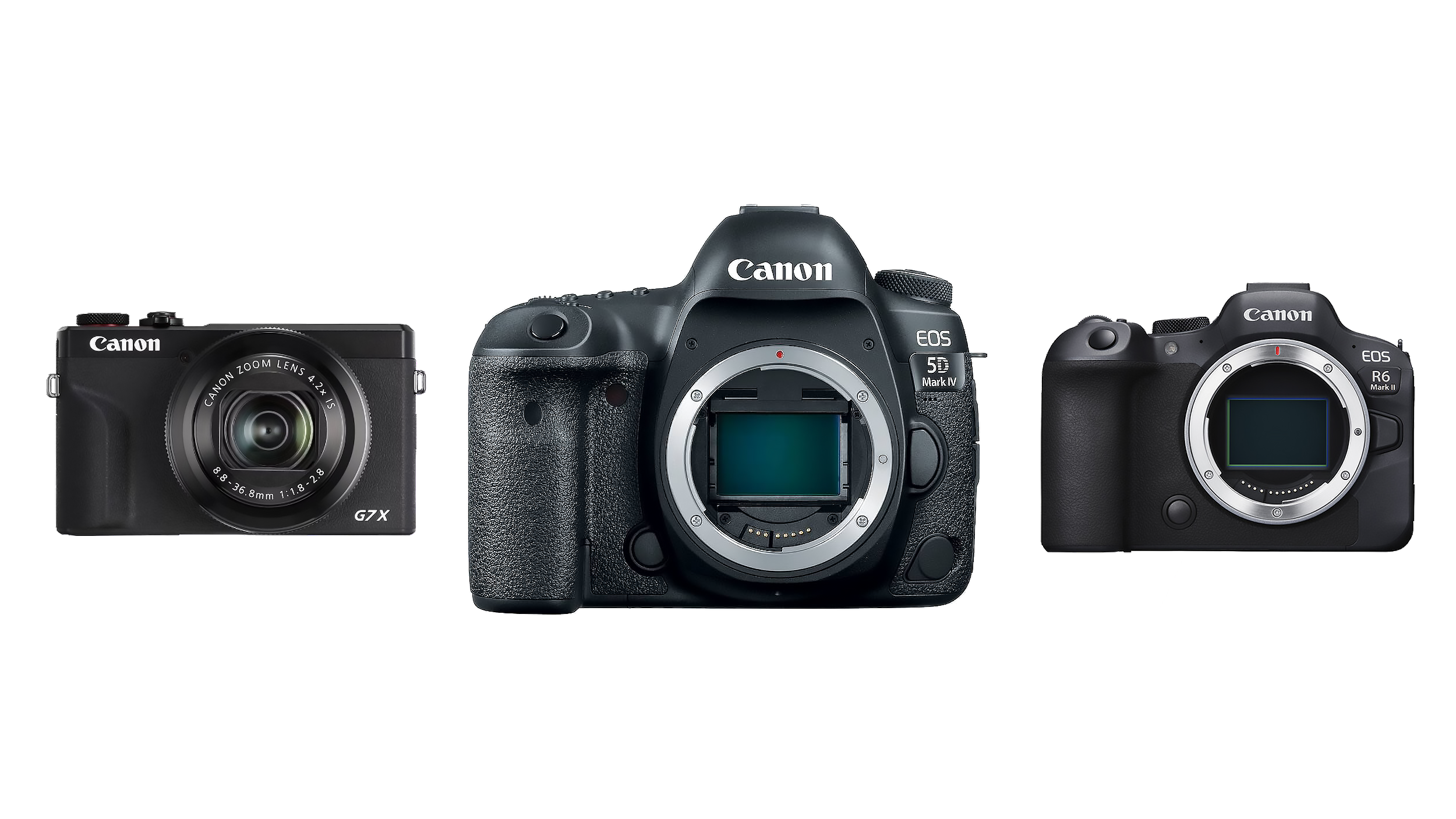
Premium compact cameras improve on this formula. Models such as the Canon PowerShot G7 X Mark III and the Sony RX100 VII use larger 1-inch sensors and brighter lenses. These cameras offer improved dynamic range, better high ISO performance, and more advanced autofocus systems.
Even at this level, physical limitations remain. The lens cannot be changed. Sensor size is smaller than APS-C or full frame. Skill remains the deciding factor in image quality.
Bridge Cameras: Extreme Zoom and Optical Physics
Bridge cameras expand capability by increasing zoom range rather than sensor size.
Models such as the Nikon Coolpix P1000 offer extreme equivalent focal lengths. Equivalent focal length describes framing relative to full frame, not light gathering.
Most bridge cameras use 1/2.3 inch sensors, and some higher-end models use 1-inch sensors. Small sensors limit low-light flexibility. At long focal lengths, shutter speed must increase to prevent motion blur. As aperture narrows at longer focal lengths, ISO rises quickly.
Atmospheric distortion becomes significant at extreme distances. Heat shimmer and air movement can soften detail regardless of lens quality.
Understanding exposure balance, environmental conditions, and motion control becomes essential to maximize performance at this tier.
Entry-Level Interchangeable Lens Cameras
This is where creative control expands significantly.
APS-C sensors gather substantially more light than compact or bridge systems. Dynamic range improves. Depth of field becomes more controllable. High ISO performance expands.
Interchangeable lenses allow specialization. A fast prime lens enables shallow depth of field and improved low-light shooting. Telephoto lenses provide reach. Wide-angle lenses enhance landscapes.
Autofocus systems improve, especially in mirrorless designs where focus is evaluated directly on the imaging sensor. Real-time exposure preview in electronic viewfinders shortens the learning curve for exposure control.
This level represents the true beginning of serious photographic growth.
Mid-Range and Enthusiast Cameras
Mid-tier cameras improve speed, precision, and durability.
Autofocus tracking becomes more reliable. Burst rates increase. Buffer depth expands. Shutter durability improves.
Models such as the Canon EOS 90D illustrate how enthusiast-level bodies refine performance for sports and wildlife photographers.
Sensor size may remain APS-C, but processor improvements enhance consistency in demanding conditions.
Technical understanding continues to define results. Faster burst rates do not compensate for incorrect shutter speed. Advanced autofocus does not eliminate environmental limitations.
Professional Full-Frame DSLRs
Full-frame DSLRs such as the Canon EOS 5D Mark IV and the Nikon D850 defined professional photography for years.
A full-frame sensor gathers more light than APS-C, improving dynamic range, tonal transitions, and high ISO performance. Depth of field control increases. Background separation becomes more pronounced when paired with fast lenses.
Build quality at this tier is robust, with weather sealing and high shutter durability.
These cameras remain capable tools. Physics does not change with product cycles. Exposure discipline, environmental awareness, and timing still determine image quality.
The next transition was not about increasing sensor size further. It was about changing how the camera sees, focuses, and processes information by removing the mirror entirely.
DSLR vs Mirrorless: What Changed
The transition from DSLR to mirrorless was a structural shift.
DSLRs use a mechanical mirror to reflect light into an optical viewfinder. Mirrorless systems remove that mirror, allowing light to reach the sensor at all times.
Autofocus is measured directly on the imaging plane. Electronic viewfinders display exposure adjustments in real time. Burst rates increase without mirror movement.
Advanced mirrorless models such as the Canon EOS R5 and the Sony A1 incorporate subject recognition and fast sensor readout speeds.
Despite technological advancements, foundational physics remain unchanged. Sensor size governs light gathering. Exposure decisions govern tonal detail. Environmental factors still influence clarity.
Modern Mirrorless Tiers: Entry to Flagship
Mirrorless systems exist across multiple tiers.
Entry-level APS-C mirrorless bodies such as the Canon EOS R50 provide strong autofocus performance and portability.
Flagship full-frame mirrorless models such as the Nikon Z8 incorporate stacked sensors, faster readout speeds, and advanced subject tracking.
Dynamic range and low-light flexibility are strongest at the full-frame flagship level. However, environmental limitations and exposure decisions still determine results.
Tier vs Generation: Why Newer Is Not Always Higher
Tier refers to structural capability. Generation refers to release timing.
A professional DSLR from several years ago may outperform a new entry-level mirrorless camera in durability and dynamic range, while lacking modern autofocus intelligence.
Understanding this distinction prevents confusion when comparing models across product cycles.
How to Choose the Right Camera Level
Choose based on subject matter and shooting conditions.
Sports and wildlife require strong autofocus and burst speed. Landscapes benefit from dynamic range. Portraits benefit from depth of field control. Travel may prioritize portability.
Higher-tier cameras expand capability. Knowledge determines how much of that capability is realized.
Camera Level Comparison
The table below summarizes the differences discussed above.
| Camera Level | Sensor Size | Lens System | Best For |
|---|---|---|---|
| Basic Compact | 1/2.3 inch | Fixed | Casual snapshots |
| Premium Compact | 1 inch | Fixed | Travel and portability |
| Bridge Camera | 1/2.3 inch or 1 inch | Fixed superzoom | Distant subjects in daylight |
| APS-C Interchangeable | APS-C | Interchangeable | Learning and creative control |
| Full-Frame DSLR | Full frame | Interchangeable | Professional dynamic range |
| APS-C Mirrorless | APS-C | Interchangeable | Enthusiast action |
| Full-Frame Mirrorless | Full frame | Interchangeable | Professional sports and wildlife |
Whether you are comparing DSLR vs mirrorless systems, choosing between APS-C and full frame, or deciding on the best camera for beginners, the differences above define capability. Image quality, however, ultimately depends on how well the photographer understands exposure, light, motion, and environmental conditions.
Frequently Asked Questions
Is mirrorless better than DSLR?
Mirrorless systems offer more advanced autofocus tracking and real-time exposure preview. DSLRs remain capable tools with strong durability.
Is full frame worth it for beginners?
Full-frame cameras offer improved dynamic range and low-light performance, but APS-C systems provide excellent image quality for most photographers.
What is the difference between APS-C and full frame?
Full-frame sensors are larger and gather more light, improving dynamic range and depth of field control.
Are point-and-shoot cameras still worth buying?
Basic point-and-shoot cameras have largely been replaced by smartphones. Premium compact cameras remain valuable for portability with improved image quality.